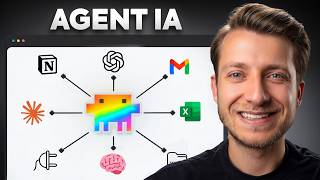
Actually: Technical architecture, MCP protocol, multi-agent reliability, and security risks like prompt injection.
🔎 What’s inside
⚡ The gist in 30 seconds
- An AI agent is not just a model; it is a model paired with a 'harness'—a program that executes actions like searching the web or sending emails based on the model's text output.
- The Model Context Protocol (MCP) is a new universal standard (like USB-C for AI) that allows agents to connect to various data sources like Gmail, Slack, and databases through a single interface.
- Agents often fail due to 'context rot,' where long conversation histories dilute the model's attention, causing it to forget initial instructions or safety constraints.
- Reliability is achieved through 'Evals' (automated testing) and multi-agent systems, where a manager agent delegates tasks to sub-agents to keep context windows small and focused.
- Security remains a critical risk; 'prompt injection' can occur when an agent reads malicious instructions on a third-party website that override the user's original commands.
⏱ Key moments click — the video jumps there
💰 Numbers
| Public MCP servers | 10,000+ as of December 2025 (shown on screen) |
| Multi-agent performance boost | 90.2% success vs single agent in Anthropic tests (shown on screen) |
| Token usage | Multi-agent systems use ~15x more tokens than simple chats (author's claim) |
| Task complexity growth | Tasks agents can solve double in length every 4 months (shown on screen) |
🛠 Tools from the video
🚀 How to apply it in your business
- Start with simple prompts in ChatGPT or Claude before investing in custom agent development.
- Use the 'Notepad' method: instruct your agent to store its plan in a separate file to prevent it from forgetting the goal as the chat grows.
- Restrict agent permissions at the harness level; for example, require a manual 'Yes' button for any delete or send action.
- Create 'Evals': a set of 20-50 real-world test cases to run every time you update your agent's instructions.
- Isolate tasks: if an agent needs to browse the web, do not give it access to your private database in the same session.
Who will this analysis save an hour?We’ll send the link with the “actually” takeaway — they won’t have to watch the whole video.
🎯 Who it’s for
❓ Questions and answers
What are ИИ агенты (AI agents) for business?
AI agents are systems that combine a language model with a software harness to perform autonomous tasks. Unlike simple chatbots, they can use tools like browsers, email, and databases to complete multi-step workflows without constant human intervention.
Why do AI agents fail on complex tasks?
Failure is usually caused by 'context rot.' As the conversation history grows, the model's attention is spread too thin, leading it to ignore initial instructions or make logic errors. Using sub-agents to handle smaller parts of a task helps solve this.
How can I connect my company data to an AI agent?
The most efficient way is using the Model Context Protocol (MCP). It acts as a universal plug, allowing you to connect your AI to Gmail, Slack, or your internal databases using pre-built or custom MCP servers.
Are AI agents secure?
They face a risk called 'prompt injection.' If an agent reads a malicious instruction hidden on a website, it might follow that command instead of yours. Security requires limiting permissions at the program level rather than just relying on text instructions.
How do I measure the reliability of an AI agent?
Reliability is measured using 'Evals.' You create a set of test tasks with known correct answers and run the agent through them multiple times. A good agent should handle at least 8 out of 10 tasks correctly before being used in production.