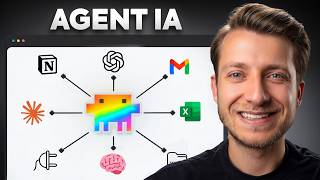
Actually: A comprehensive guide to the architecture and practical application of AI agents in 2026. It explains the 'Brain + Harness' formula, compares the costs of subscriptions versus APIs, and demonstrates real-world business automations like ad tracking, news monitoring, and automated video editing.
🔎 What’s inside
⚡ The gist in 30 seconds
- AI agents are defined by the formula 'Agent = LLM + Harness,' where the LLM acts as the brain and the harness provides the environment, tools, and file system access necessary to complete tasks autonomously.
- For most business applications, using a subscription model (like Claude Pro or Max) is significantly more cost-effective than an API, as agents often use millions of tokens across multiple iterative steps.
- Starting with a single agent on a local computer using a harness like Codex or Claude Code is more practical for business owners than building complex multi-agent cloud systems.
- Effective delegation to an agent requires a three-part prompt structure: defining the desired outcome, setting the effort/budget limits, and establishing clear verification criteria.
⏱ Key moments click — the video jumps there
💰 Numbers
| Routine tasks automated | 90% (author's claim) |
| Post-production speed increase | x2-3 (author's claim) |
| Claude Pro monthly cost | $20 (shown on screen) |
| Claude Max monthly cost | $100 (shown on screen) |
| RTX 4090 price range | 250-350k RUB (shown on screen) |
| Value of tokens in Claude Pro vs API | $211 vs $20 (shown on screen) |
🛠 Tools from the video
🚀 How to apply it in your business
- Identify one recurring manual task, such as weekly report generation, to delegate to an agent.
- Install a local harness like Codex or Claude Code to give the AI access to your project files.
- Create a 'Skill' by providing the agent with a folder containing instructions, templates, and examples of successful past work.
- Set up a global skills folder at .agents/skills to ensure all your agent harnesses share the same business logic.
- Use a Cron schedule to trigger your agent to perform data collection or monitoring tasks at specific times daily.
Who will this analysis save an hour?We’ll send the link with the “actually” takeaway — they won’t have to watch the whole video.
🎯 Who it’s for
❓ Questions and answers
What is the difference between a chatbot and an AI agent?
A standard chatbot like ChatGPT predicts the next word to answer a prompt. An AI agent uses an LLM as a brain but is embedded in a 'harness' that gives it tools to browse the web, read/write files, and run code. Agents can work in loops, checking their own progress until a final business goal is achieved.
Are ИИ агенты для бизнеса expensive to run?
Running agents via API can be very expensive because they use millions of tokens to complete complex tasks. However, using a subscription like Claude Pro ($20) or Max ($100) provides much higher value, often giving you 10 times more token usage than you would get for the same price via API.
Can I run AI agents locally for better privacy?
Yes, you can run agents locally using tools like Ollama or LM Studio combined with a harness like Codex. This keeps your data on your own hardware, but you will need a powerful computer with a high-end graphics card (like an RTX 3090 or 4090) to run models that are smart enough for complex business tasks.
How do I teach an AI agent specific business skills?
You teach agents by creating 'Skills,' which are folders containing a system prompt, reference documents, and examples of the desired output. By placing these in a specific directory that the agent harness can read, the agent gains the context needed to perform specialized tasks like drafting contracts or posting to your specific CMS.