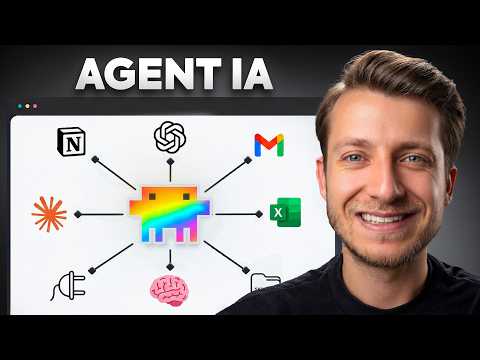
Actually: Build AI agents using MCP and AGENTS.md; saves 20% on tokens via model switching.
🔎 What’s inside
⚡ The gist in 30 seconds
- Transition from browser-based LLMs to local agents like Codex or Claude Code that have direct access to your terminal and file system.
- Use structured configuration files (AGENTS.md) to define project architecture, tech stacks, and strict prohibitions to prevent agents from making costly mistakes.
- Implement the Model Context Protocol (MCP) to connect AI agents to business tools like Jira, Confluence, and production databases for real-world data access.
- Optimize operational costs by using high-reasoning models for planning while delegating mechanical tasks to cheaper, faster models.
- Establish verification loops where agents automatically run tests and linters to self-correct their work before a human ever sees it.
⏱ Key moments click — the video jumps there
💰 Numbers
| Context bloat example | 300,000 tokens consumed by unmanaged test logs (author's claim) |
| Config file limit | 100-200 lines recommended for AGENTS.md to avoid hallucinations (author's claim) |
| Efficiency gain | 10-20% token savings through model switching (author's claim) |
🛠 Tools from the video
🚀 How to apply it in your business
- Create an AGENTS.md file in your project root to define coding standards and prohibited actions for AI.
- Set up an MCP server to allow your AI agents to read internal documentation in Confluence.
- Build 'skills' as checklists for common tasks like API endpoint creation or database migrations.
- Configure a sub-agent specifically for code review to catch errors before human review.
- Implement a verification loop that requires the AI to pass all unit tests before submitting a task.
Who will this analysis save an hour?We’ll send the link with the “actually” takeaway — they won’t have to watch the whole video.
🎯 Who it’s for
❓ Questions and answers
How can ИИ агенты improve business development?
AI agents move beyond simple chat by executing commands, reading files, and interacting with tools like Jira. This allows them to handle entire features or bug fixes autonomously, significantly speeding up the development cycle.
What is the best way to implement ИИ агенты для бизнеса?
Start by defining clear instructions in an AGENTS.md file and using the Model Context Protocol (MCP) to give the agent access to your business data. This ensures the agent has the context needed to make informed decisions.
How do I control the costs of AI agents?
Use a 'high-reasoning' model for the initial planning phase, then switch the agent to a cheaper 'low-cost' model for mechanical implementation tasks. This can reduce token expenses by up to 20%.
What are verification loops in agentic development?
Verification loops are automated processes where the agent runs tests or linters after completing a task. If it fails, the agent uses the error output to fix its own code, repeating the process until the task is verified as correct.